
What’s happening: The Department of Health Care Services (DHCS) will host a public webinar on July 9 from 3:30 to 5 p.m. (PT) to discuss its long-term vision for advancing value in Medi-Cal.
(more…)DHCS to Host July 9 Webinar on Value Strategy
Financial Indicator Analysis Now Available
What’s happening: CHA DataSuite has issued hospital-specific financial indicator analysis using first-quarter 2026 data from the Healthcare Cost Report Information System.
(more…)HCAI Releases New Details on CalRHT Funding Opportunities
What’s happening: The Department of Health Care Access and Information (HCAI) this week released details on forthcoming grants under the California Rural Health Transformation (CalRHT) program. The first opportunity is intended for “accelerator partners,” aimed at supporting collaborative models to strengthen primary and maternity care in rural communities; a grant guide is now available and applications will open later this month.
(more…)Infographic: Artificial Intelligence Has the Potential to Improve Nearly Every Aspect of Health Care
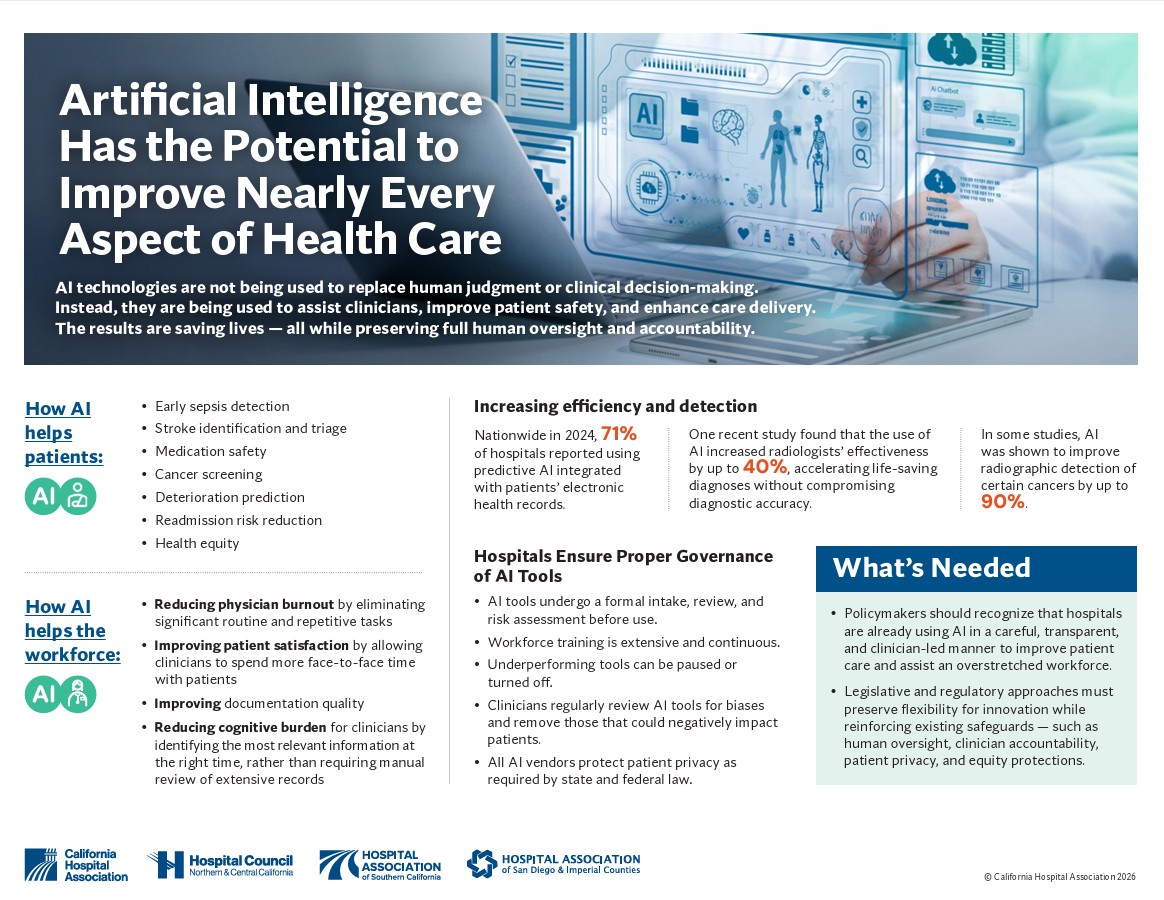
Key Messages: Responsible AI Use Is the Foundation of California’s Health Care Future
Artificial intelligence (AI) doesn’t replace human judgment — it supports clinicians, improves patient safety, and enhances care delivery.
(more…)Issue Brief: Responsible AI Use Is the Foundation of California’s Health Care Future
The Issue
Artificial intelligence (AI) is increasingly being used in hospitals to assist clinicians, improve patient safety, and enhance care delivery — and the results are saving lives.
With predictive analytics and early warning systems — such as sepsis detection tools — clinicians are able to identify patterns that may signal patient deterioration or infection sooner than traditional methods and enable earlier intervention. In some studies, AI was shown to improve radiographic detection of certain cancers by as much as 90% over radiologists. And language access and health-literacy tools are helping reduce barriers for patients with limited English proficiency.

At the same time, AI is helping reduce clinician burnout and improve patients’ experience. By reducing time spent on documentation, AI allows physicians to focus on patients instead of computers during appointments, leading to higher patient satisfaction. Patient acceptance is high; one health system reports more than 95% of patients consent to the use of AI scribes and appreciate the increased attention.
Importantly, AI technologies are not replacing human judgment or clinical decision-making. Instead, they function as tools that help clinicians manage information, reduce non-clinical workload, and identify risks earlier — while preserving human oversight and accountability. AI is helping patients and clinicians with:
- Early Sepsis Detection
- Stroke Identification and Triage
- Medication Safety
- Cancer Screening
- Deterioration Prediction
- Readmission Risk Reduction
Health care providers ensure that a “human is in the loop” when using AI. Clinical decisions are made by licensed professionals, not algorithms, and clinicians retain full responsibility for patient care. For example, AI-powered ambient scribe tools draft clinical notes based on clinician-patient conversations, but physicians must review and sign every note before it becomes part of the medical record. Similarly, nurses must validate AI-generated shift summaries.
Hospitals are using AI cautiously and responsibly, guided by strong governance and transparency. Every AI tool undergoes formal review before deployment — underperforming systems are paused or deactivated until they meet established standards. Hospitals also require HIPAA compliance and legal accountability.
What’s Needed
Policymakers should recognize that hospitals are already using AI in a careful, transparent, and clinician-led manner to improve patient care and support an overstretched workforce. Legislative and regulatory approaches must preserve flexibility for innovation and efficiency while reinforcing existing safeguards — such as human oversight, patient privacy, and equity protections.
Key Messages: Facility Fees Help Keep Health Care Services Close to Home
Facility fees support the clinical staff, infrastructure, and services needed to provide care in community-based outpatient settings — keeping clinics open and accessible, supporting high-quality care, and enabling patients to receive care close to home and avoid a hospital emergency department (ED).
(more…)The Facts on AB 225 (Bonta)

MYTH: Eliminating facility fees will result in lower health care costs for patients.
FACT: Eliminating facility fees could actually increase costs by forcing patients to receive care in higher-cost settings. Without facility fees, telehealth services and community clinics may close, leaving patients with fewer options and increased reliance on hospital emergency departments. Keeping care in lower-cost settings helps reduce costs.
(more…)Bill Brief: Californians Need Access to Community-Based Care
The Issue
Hospital-based outpatient clinics are an essential part of California’s health care delivery system. They provide primary, specialty, and urgent care; behavioral health, oncology, and telehealth services; and chronic disease management. These clinics are an essential part of the health care safety net and care for patients regardless of insurance status, including Medi-Cal beneficiaries who face significant barriers to accessing timely care.
Assembly Bill 225 would prohibit hospitals and health systems from being reimbursed for off-campus patient visits that require evaluation and management services, and all telehealth and preventive services, regardless of where the patient or provider is located.
While intended to reduce health care costs, the bill would instead threaten access to community-based care and increase costs for patients.
Several key facts illustrate why this policy would have the opposite of its intended effect:
- By delivering care in lower-cost health care settings, like urgent care clinics and telehealth, Californians pay less in copays and coinsurance than if they had to receive those services in emergency departments (EDs) or other hospital settings. Reducing access to these services would drive patients into more expensive settings, increasing costs for patients, payers, and the health care system.
- Facility fees help cover the costs of operating these clinics, including staffing, care coordination, interpreter services, technology, compliance activities, and other infrastructure necessary to support patient care. Unlike physician offices, hospital-based outpatient clinics operate under a hospital’s license and must comply with extensive state and federal requirements related to patient safety, quality improvement, credentialing and peer review, nursing oversight, infection prevention, emergency preparedness, charity care, and physical plant and life-safety standards.
- Eliminating facility fees would force hospitals to reduce clinic hours, scale back services, limit telehealth capacity, re-evaluate staffing levels, and, in some communities, close outpatient clinics altogether. This would force patients to seek care in already-crowded EDs (2025 set a record for ED visits in California).
What’s Needed
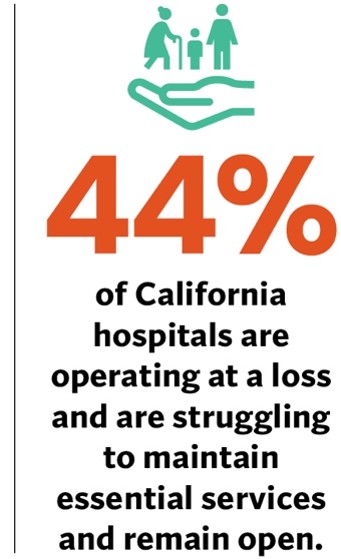
At a time when 44% of hospitals are operating at a loss and are struggling to maintain essential services and remain open, California should not eliminate hundreds of millions to billions of dollars in funding that supports community-based clinical capacity and keeps care close to home. Policymakers should pursue strategies that lower health care costs without undermining access, destabilizing hospitals, or shifting patients into higher-cost emergency and inpatient settings
California Hospital Association, Labor Unions Withdraw Ballot Measures
SACRAMENTO (June 25, 2026) — Following an agreement among the California Hospital Association (CHA), the California Federation of Labor Unions, AFL-CIO, and SEIU-UHW, the following two initiatives have been withdrawn from the November ballot:
- The Health Care Transparency, Accountability & Union Member Right to Vote Act
- The Health Care Executive Compensation Act of 2026
“Today marks an important step in strengthening the health care system to ensure high-quality health care services are accessible throughout California,” said Carmela Coyle, CHA President & CEO.