Bill Brief: Californians Need Access to Community-Based Care
The Issue
Hospital-based outpatient clinics are an essential part of California’s health care delivery system. They provide primary, specialty, and urgent care; behavioral health, oncology, and telehealth services; and chronic disease management. These clinics are an essential part of the health care safety net and care for patients regardless of insurance status, including Medi-Cal beneficiaries who face significant barriers to accessing timely care.
Assembly Bill 225 would prohibit hospitals and health systems from being reimbursed for off-campus patient visits that require evaluation and management services, and all telehealth and preventive services, regardless of where the patient or provider is located.
While intended to reduce health care costs, the bill would instead threaten access to community-based care and increase costs for patients.
Several key facts illustrate why this policy would have the opposite of its intended effect:
- By delivering care in lower-cost health care settings, like urgent care clinics and telehealth, Californians pay less in copays and coinsurance than if they had to receive those services in emergency departments (EDs) or other hospital settings. Reducing access to these services would drive patients into more expensive settings, increasing costs for patients, payers, and the health care system.
- Facility fees help cover the costs of operating these clinics, including staffing, care coordination, interpreter services, technology, compliance activities, and other infrastructure necessary to support patient care. Unlike physician offices, hospital-based outpatient clinics operate under a hospital’s license and must comply with extensive state and federal requirements related to patient safety, quality improvement, credentialing and peer review, nursing oversight, infection prevention, emergency preparedness, charity care, and physical plant and life-safety standards.
- Eliminating facility fees would force hospitals to reduce clinic hours, scale back services, limit telehealth capacity, re-evaluate staffing levels, and, in some communities, close outpatient clinics altogether. This would force patients to seek care in already-crowded EDs (2025 set a record for ED visits in California).
What’s Needed
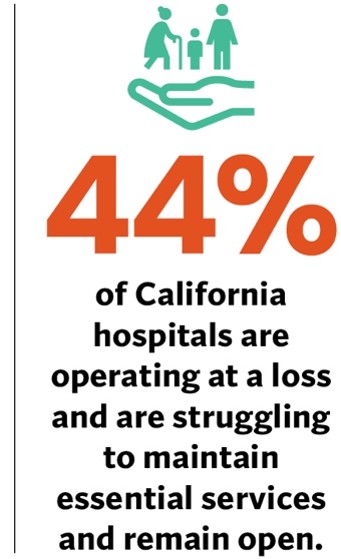
At a time when 44% of hospitals are operating at a loss and are struggling to maintain essential services and remain open, California should not eliminate hundreds of millions to billions of dollars in funding that supports community-based clinical capacity and keeps care close to home. Policymakers should pursue strategies that lower health care costs without undermining access, destabilizing hospitals, or shifting patients into higher-cost emergency and inpatient settings
California Hospital Association, Labor Unions Withdraw Ballot Measures
SACRAMENTO (June 25, 2026) — Following an agreement among the California Hospital Association (CHA), the California Federation of Labor Unions, AFL-CIO, and SEIU-UHW, the following two initiatives have been withdrawn from the November ballot:
- The Health Care Transparency, Accountability & Union Member Right to Vote Act
- The Health Care Executive Compensation Act of 2026
“Today marks an important step in strengthening the health care system to ensure high-quality health care services are accessible throughout California,” said Carmela Coyle, CHA President & CEO.
CHA Advocacy Strengthens APOT Audit Tool Responsibilities in Final Regulations
What’s happening: Last week, the state Emergency Medical Services (EMS) Commission met and approved regulations focused on Assembly Bill 40 (2023) and Chapter 6 Specialty Care Designation and discuss the statewide ambulance patient offload time (APOT) report.
(more…)
Hospitals Must Complete Occupational Mix Survey by June 30
What’s happening: Hospitals are required to complete the new occupational mix survey for the federal fiscal year (FFY) 2028 wage index and submit it to their Medicare Administrative Contractor by June 30.
(more…)
Two Hospital-Specific Quality Analyses Available from CHA DataSuite
What’s happening: CHA DataSuite has issued hospital-specific analyses of the Value-Based Purchasing (VBP) Program and the Hospital-Acquired Condition (HAC) Reduction Program for federal fiscal year (FFY) 2027.
(more…)
Tool Available to Help Hospitals Find Partners to Secure Rural Health Funding
As California’s rural hospitals work to secure funding via the federal Rural Health Transformation Program (RHTP), a new tool is available to help them find partners to prepare their grant proposals.
(more…)
Hospital Field Urges OHCA Board to Reject Ruinous Penalties
What’s happening: Organizations representing nearly 150 hospitals wrote or commented at this week’s Office of Health Care Affordability (OHCA) board meeting asking the board to reject OHCA’s proposed penalties, which could be in the hundreds of millions of dollars for even a single-year violation of the spending targets. Hospitals shared the disastrous consequences such exorbitant penalties would have on their ability to care for patients and reminded OHCA of its duty to protect access to care as it promotes improved affordability.
(more…)
In Latest Budget Proposal, Lawmakers Prioritize Californians
This week, the Legislature advanced its own version of the state budget in a suite of bills that take critical steps toward shoring up health care across California.
(more…)
Summaries Detail Changes to Medicaid Payments, Work Requirements
What’s happening: CHA is sharing two analyses prepared by Health Policy Alternatives (HPA) that cover Medicaid rules on directed payments and targeted supplemental payments as well as the implementation of community engagement (work requirement) provisions.
(more…)
Immediate Action Needed for Prescribers: Ensure Enrollment as Medi-Cal FFS Provider
What’s happening: Claims and prior authorizations will not be processed by Medi-Cal Rx if the prescribing health care provider is not enrolled in Medi-Cal fee-for-service (FFS) with a Type 1 National Provider Identifier. Prescribers not yet enrolled should immediately submit their Medi-Cal provider enrollment application via the Provider Application and Validation for Enrollment page.
(more…)