Sunny Sharma, MD, is used to advising his patients to do their research — and when he experienced hearing loss after having a viral infection, he followed his own advice. After an MRI revealed an acoustic neuroma, Dr. Sharma read research articles, met with several local doctors for referrals, and joined support groups to learn more. UC San Diego Health’s name came kept coming up, so he turned to their acoustic neuroma experts for care. Eventually, he was able to reclaim his dream of running the Chicago Marathon.
(more…)Physician Reclaims His Marathon Dream After Surgery to Remove Tumor
Rural Health Care Matters
I had the privilege earlier this week to welcome and join one of the most important gatherings of rural health care leaders in California: CHA’s annual Rural Health Care Symposium.
(more…)Recording of Hospital Fee Program Executive Briefing Now Available
What’s happening: A recording of CHA’s March 18 executive briefing on the Hospital Fee Program is now available for members who may have missed it.
(more…)New Documents Available on Rural Health Transformation Program
What’s happening: The Department of Healthcare Access and Information (HCAI) has released two documents — FAQs and briefing slides — on the Rural Health Transformation Program (RHTP).
(more…)CHA Joins Lawmakers, Hospital Leaders at San Diego Health Care Roundtable
What’s happening: On March 20, CHA participated in a health care roundtable hosted by Sen. Catherine Blakespear (D‑Carlsbad) and Scripps Health. The event, which was held at Scripps Memorial Hospital Encinitas, brought together California lawmakers and health care leaders from the San Diego region to discuss key issues hospitals are facing.
(more…)OHCA Board Pushes for Reconsideration of High-Cost Hospital Designations
What’s happening: The Office of Health Care Affordability (OHCA) board met on March 25, where it pushed the office to create a process to revise “high-cost” hospital determinations if based on faulty data. The board also deliberated over the process for providers to obtain adjustments to their spending targets related to the growth in non-supervisory organized labor costs.
(more…)Medicaid State-Directed Payments Help Ensure Patient Access to Care
About State-Directed Payments (SDPs)
SDPs are additional payments made to health care providers to support Medicaid quality and access goals. The Centers for Medicare & Medicaid Services (CMS) reviews and approves SDPs for each 12-month rating period. Payments to providers are made via managed care organizations (MCOs) and are based on utilization of Medicaid services. Every year, states must demonstrate that SDPs are actuarially sound and result in reasonable and appropriate provider payment levels. In addition, CMS requires evaluation plans that demonstrate payments are effective in meeting program access and quality objectives.
Read on for more frequently asked questions about SDPs in California:
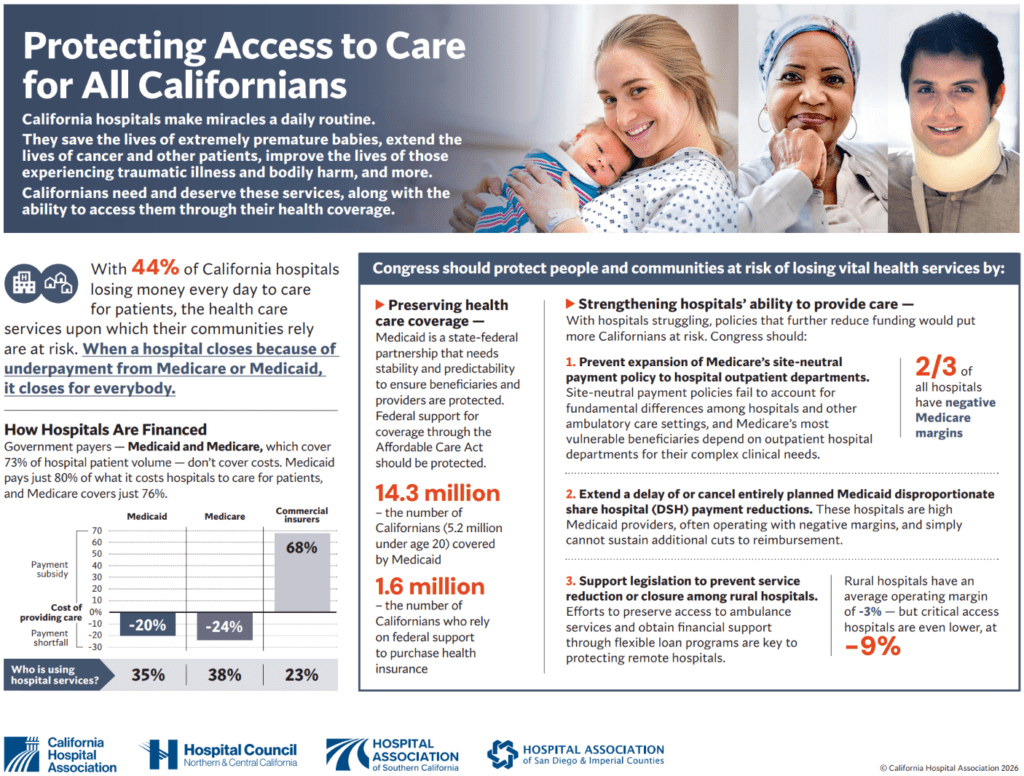
Health care access would be at grave risk without these funds. For many hospitals, losing this revenue would mean closure of service lines; for others, it would threaten their viability altogether. That means million of Americans — regardless of what type of insurance they have — would lose access to their health care providers.

Medicaid Provider Taxes Protect Californians’ Access to Care
Medicaid provider taxes are a cornerstone of the Medicaid financing structure.
Without federal revenue generated from these taxes, reimbursement for care provided to patients covered by Medicaid would be woefully insufficient and health care access would be at grave risk. For many hospitals, losing this revenue would mean closure of service lines; for others, it would threaten their viability altogether.
Cutting Medicaid means millions of Americans — regardless of what type of insurance they have — would lose access to their health care providers.
Medicaid and California’s hospital tax
- In California, Medicaid pays 80 cents for each dollar spent on care; without the additional payments from the hospital tax, reimbursement would drop to just 70 cents on the dollar.
- The federal Medicaid statute expressly authorizes provider taxes as permissible sources of funding the nonfederal share of program expenditures, in recognition of finite state revenue
sources. - State Medicaid agencies work closely with CMS to ensure provider taxes comply with all federal requirements and CMS must approve every program year after year. California’s hospital tax program has been approved for more than 10 years.

- Forty-five states rely on a form of a hospital tax. California’s hospital tax program is broadly similar to states such as Indiana, Tennessee, West Virginia, Georgia, and Nebraska.
- Approximately one-third of Californians are covered by Medicaid — nearly 15 million people. Without
the hospital field’s ability to self-finance additional payments via the hospital tax, some 150 hospitals in California would lose money — greatly increasing the risk of service line and facility closures. - Hospitals pay provider taxes to the state before receiving any federal funds to care for patients. This is increasingly difficult to do with more than half of hospitals in California currently losing money.
CHA Document Details Considerations for Freestanding ED Model
What’s happening: Recognizing that some hospital leaders have expressed interest in the concept of freestanding emergency departments (EDs) — which are not currently permitted in California — CHA has developed a document that outlines the current regulatory landscape and key considerations for this type of service model.
(more…)State Files Revised Hospital Fee Program Application
What’s happening: Last week, the California Department of Health Care Services (DHCS) submitted its revised Hospital Fee Program tax model for calendar year 2025 (Program 9) to the Centers for Medicare & Medicaid Services (CMS).
(more…)